Author Archives for kd_Admin
 October 27, 2026 1:21 pm
Published by kd_Admin
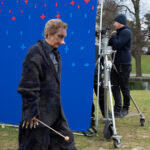
What happens when a childhood hero becomes a vehicle for political power? Miki Škorpil sits with the artists behind The Silence of the Mole, the Czech and Slovak Pavilion at La Biennale, to discuss stolen fantasies, silenced instruments, and the uneasy boundary between shelter and paranoia. Moving between Krteček, Kafka’s burrow, and the politics of cultural representation, they reflect on imagination as a site of vulnerability and a possibility for collective resistance against the surge of far-right politics.
 September 11, 2026 12:22 pm
Published by kd_Admin
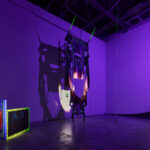
Czech writer Vít Bohal, a researcher of xenology and occultism, visits Lőrinc Borsos’ Spectre in the Wedge at MeetFactory in Prague. The text explores the exhibition’s treatment of the car as a technological and cultural fetish, tracing its seductive, violent and occult dimensions—from Futurism and consumer desire to Eastern European fantasies of Western luxury. Through a dismantled car, Bohal argues that Lőrinc Borsos turns the fetish into an object of exorcism.
 August 20, 2026 12:20 pm
Published by kd_Admin
“Ethereal Robes of Vulnerability,” hosted by Žeimiai Manor House (Aikas Žado Laboratory), brings together six emerging Eastern European artists whose practices explore the shifting life of the image. Moving between photography, video, sculpture, and installation, the exhibition considers images as material and relational surfaces—sites where bodies, technologies, memories, and non-human worlds meet.
 August 19, 2026 9:04 am
Published by kd_Admin
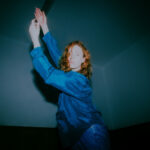
In the context of the new work Phoenix.Sun, premiering in Berlin at Tanz im August (August 2026) dancer and artist/writer Kasia Wolińska discusses fire as a force of destruction and regeneration, the entanglement of pain and pleasure in dance, and the precarious conditions of artistic production—what it means to create, perform, and believe in a time of uncertainty.
 July 3, 2026 11:00 am
Published by kd_Admin
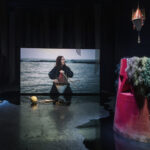
The project representing Romania at the 2026 La Biennale di Venezia unfolds across two venues. The Pavilion in the Giardini presents a polyphonic installation of sound, moving image, and sculptural instruments, approaching the Black Sea as a site of acoustic memory, ecological transformation, and geopolitical tension.
In the Palazzo Correr, the project extends beyond the Black Sea, tracing its connections to wider planetary systems of extraction, circulation, and interdependence.
 July 2, 2026 11:55 am
Published by kd_Admin
Less concerned with propaganda at its loudest than with the moment it ceases to be heard, the exhibition follows how political imagery slips into everyday routines: a pin fastened to a shirt, an illustration adorning a magazine, a monument inhabiting a field. Once charged with ideological purpose, these symbols become ordinary, almost invisible, woven into the visual texture of daily existence and, through repetition, into collective imagination itself. By reworking these icons of the past, Andreea Ilie reveals how visual culture endures precisely when and because it appears most natural.
 June 29, 2026 2:19 pm
Published by kd_Admin
Performer and choreographer Boglárka Börcsök, filmmaker Andreas Bolm, and curator and researcher Katalin Erdődi get together in a roundtable discussion; they talk about avant-garde dance movements and Hungarian art history in feminist perspective, filmmaking at the intersection between documentary and speculative exploration, age, vitality and silence, and ultimately returning ghosts that re-write history through a transformative choreography of memories.
 June 26, 2026 1:09 pm
Published by kd_Admin
Working on the fine line between installation and photography, Gedvilė Tamošiūnaitė divines the future using techniques evocative of the past. Her silkscreen prints informed by the look of obsidian remind us not only of this magical stone but also of the screens we so often depend on in our everyday life. As with our devices, we can catch glimpses of ourselves in Gedvilė's work and be confronted with "a healthy terror of being alive." Read the exhibition text of the curator, Eglė Ambrasaitė, below.
 June 23, 2026 2:07 pm
Published by kd_Admin
In 2010, the world’s largest Jesus statue was erected in the town of Świebodzin in western Poland. It is called Jesus Christ, King of the Universe. Take that, Rio Jesus; the Świebodzin iteration of the Lord’s likeness is not merely grander in stature—his reach is cosmic. From his Świebodzin home, he does not simply look down on his earthly flock, but up to the ungraspable cosmos. He also watches over a Tesco.
 June 19, 2026 12:00 pm
Published by kd_Admin
“Chemical Bonds” transforms invisible processes into accessible installations and narratives, drawing on research into the transformation of Romania’s chemical industry led by Norbert Petrovici together with Mihai Iacob and Zoltán Mihály. Tracing its development from the integrated industrial ecosystem of the 1970s and '80s to the present day, the research reveals an industry that is vulnerable, yet holds significant potential for innovation.
 June 15, 2026 2:44 pm
Published by kd_Admin
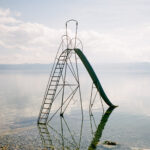
Writer and curator Alicja Melzacka plunges into a kaleidoscope of constellations that uncover overlapping pasts, presents, and futures. By relying on Estonian-born, Belgium-based artist Ingel Vaikla’s work Shapes and Distances (2020), these constellations are to be read as intersections between various temporal realms, between archival footage, film, politics, and architecture, as well as between failed utopia, short-lived realities, and unrealised futures.
 June 9, 2026 1:53 pm
Published by kd_Admin
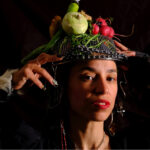
In connection with the publication of his latest photobook, Svijet, photographer Dominik Wojciechowski reflects on Yugonostalgia, post-Yugoslav identities, nationalism, and the enduring legacies of socialism. A contributor to Kajet's second issue, On Utopias, Dominik spoke with us about what draws him to these themes, who the people in his photographs are, and what value the photobook still holds as an object in an increasingly digital world.
 June 4, 2026 1:49 pm
Published by kd_Admin
In their first collaboration, dancer-choreographer Boglárka Börcsök, actress Orsolya Török-Illyés, and film director Andreas Bolm evoke one of the most radical figures of international Dada, Baroness Elsa von Freytag-Loringhoven (1874–1927). Through a performative walk that culminates in a concert, they revive the Baroness’s subversive artistic spirit, shaped by her urban interventions, poetry, and ready-made works.
 May 29, 2026 8:24 am
Published by kd_Admin
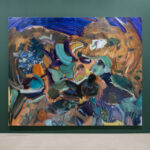
The Silence of the Mole is currently on view at the 61st International Art Exhibition of La Biennale di Venezia, marking the 100th anniversary of the opening of the Czechoslovak Pavilion. In the anniversary year of 2026, the Czech and Slovak Republics have reunited for a joint presentation after twenty years.
 May 21, 2026 12:34 pm
Published by kd_Admin
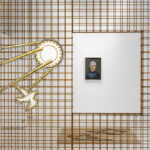
Spanning two generations already, the 'Cluj School' is a tour de force in contemporary figurative painting, blending technique and conceptualism to create a diverse set of works. The Telegraph Gallery Olomouc is hosting an exhibtion titled Transylvanian Painting Today from the 5th of March to the 11th of June, which seeks to relay this loosely connected group to the Czech public.
 May 18, 2026 2:53 pm
Published by kd_Admin
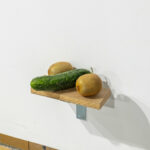
Gaep presents Construction Time Again, Vlad Nancă’s first solo exhibition with the gallery and his first solo project in Bucharest since his participation in the 2025 Venice Architecture Biennale. The exhibition imagines the relocation of modernism onto another planet through a new body of work encompassing sculpture, installation, mosaics, works on paper, and video. Looking to the past not with nostalgia but through the lens of the future we seek to inhabit, the artist reconsiders modernist forms as ethical propositions rooted in aspirations for better urban living.
 May 18, 2026 2:29 pm
Published by kd_Admin
The exhibition continues the series of serious ~ playful ~ irreverent experiments with forms of museum thinking that was initiated in 2021 and brings to the spotlight eight queer artistic practices—those of Apparatus 22, Maria Balea, Lucian Barbu, Alex Bodea, Stefan Botez, Alex Horghidan, Gavril Pop, and Sofia Zadar—through a substantial ~ eclectic ~ sophisticated selection of recent and specially commissioned works.
 September 15, 2025 8:02 am
Published by kd_Admin
Hosted by Erasmus University and scheduled to take place in April 2026, the conference seeks to critically position and explore (popular) music as a site of social meaning, power, and resistance: from production and labour to consumption, nightlife, activism, representation, and sonic practices bubbling up from the so-called margins. See the call below and submit your abstract by October 1.
 June 30, 2025 7:33 pm
Published by kd_Admin
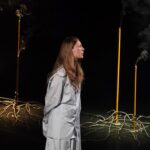
In May, Rokolectiv hosted a residency uniting SHAPE+ musician Adela Mede with artists Nona Inescu and Emilian Pospaii. Their collaboration culminated in an atmospheric live performance at the National Dance Center in Bucharest. Wearing Pospaii’s eerie costume design, Mede blended experimental electronics with Central European folklore, while Inescu shaped a fluid stage installation. The Rokolectiv team sat down with Adela and Nona to reflect on the process and resonance of their shared experience.
 November 14, 2024 12:00 pm
Published by kd_Admin
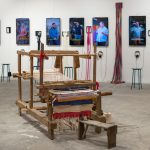
In its long and richly documented history, Timișoara’s textile industry shifted from large factories to new flexible systems of organisation. The newest exhibition at Faber in Timișoara “Woven Secrets” explores these changes, showcasing design’s role in innovation, sustainability, and reimagining production through collaborations and experimental methods.
 July 4, 2024 12:05 pm
Published by kd_Admin
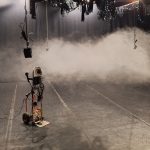
In May 2024, Rokolectiv invited Korean-born / Berlin-based musician bela to collaborate with Romanian choreographer & performer Mihai Mihalcea, and with fashion designer / visual artist Oláh Gyárfás, for a new performance at The National Dance Centre, in Bucharest. The team of Rokolectiv sat down with the artists for a quick plunge into their creative process.
 October 22, 2023 2:12 pm
Published by kd_Admin
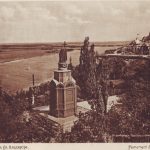
This is the first English translation of a little known essay by Mikhail Bulgakov (“Kiev – gorod”) originally published 100 years ago, in 1923. At that time, the Kyiv he portrayed was grappling with the aftermath of war, drought, famine, and infectious disease, but the text also reveals Bulgakov’s casual racism and deep-seated aversion for Ukrainian culture. The translation, swiftly crafted by Emily Finer, a writer, translator and senior lecturer at the University of St Andrews, features extensive explanatory notes and an introduction that not only offers context but redirects attention toward the text’s contemporary ramifications.
 October 2, 2023 9:45 am
Published by kd_Admin
In the context of the performative dinner put together by Montag Modus, hosted at Berlin’s Tanzfabrik, and curated by Léna Szirmay-Kalos and Kasia Wolińska, we had the privilege of talking with the Otucha Collective. Together, we delved into the depths of their sonic practice, exploring the human voice as an instrument for healing and pondering the potential to reimagine new futures by drawing from rural vocal traditions and somatic practices of Eastern Europe.
 September 6, 2023 8:39 am
Published by kd_Admin
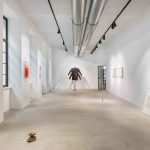
In May 2024, Rokolectiv invited SHAPE+ platform musician Petra Hermanova to collaborate with Apparatus 22, a Romanian collective of visual artists, for a new performance at The National Dance Centre, in Bucharest. The team of Rokolectiv sat down with the artists for a quick plunge into their creative process.
 August 22, 2023 8:41 am
Published by kd_Admin
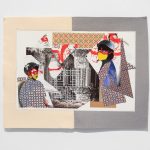
Curator and writer Alex Fisher reviews Driton Selmani’s survey exhibition, which presents a selection of works from different series in the foundation’s gallery and the public realm. With a penchant for the uncanny and a cunning engagement of subversive poetics, the artist addresses existential concerns on local and global scales.
 August 1, 2023 7:56 am
Published by kd_Admin
The latest exhibition at Budapest Gallery, curated by art historian Lívia Páldi, tackles narratives of violence, scripts of social behaviour, and visual and political themes of violence from an intersectional perspective.
 August 1, 2023 6:00 am
Published by kd_Admin
Art historian and curator Zsu Zsuró opens up a conversation with the Hollow collective (Gyula Muskovics, Tamás Páll, and Viktor Szeri) about their artistic work, the ambivalence between East and West, the necessity of physical spaces but also the potential of the digital realm, and their latest performance piece Aura that debuted this spring at Trafó House of Contemporary Arts in Budapest and was recently shown as part of the interdisciplinary event series Montag Modus at radialsystem in Berlin.
 July 16, 2023 1:47 pm
Published by kd_Admin
Curator and art critic Milena Khomchenko discusses the two iterations of the exhibition “Let the long. Road. Lead. To. Stairs in. The Heavens”, which unpacks the vision of the Ukrainian destiny after the end of Russia’s war in Ukraine. How could the notion of ‘destiny’ serve as an emancipatory network not to be just attained in the future, but also constituted by the multiplicities of past/present elements?
 July 16, 2023 11:02 am
Published by kd_Admin
The Július Koller Society’s newest exhibition in Bratislava dives deep into the archival past and re-imagines the continent through new cosmic archipelagoes. Curated by Canan Batur, the show opens up the space to speculation, new contemplative modes of operation, futurological thinking and alchemical cosmohumanism. In doing so, it imagines safer, inhabitable spaces and gives material shape to possibility.
 July 16, 2023 6:48 am
Published by kd_Admin
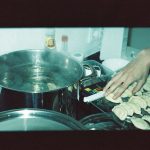
It was as a counterweight to the ‘hardest day of the week’ that the initiative Monday Kitchen emerged, we learn from founding member Vladik. It is precisely the culturally, symbolically charged and political-activist character of the varenyky preparation that brings together Ukrainians who have fled the war and their supporters: at changing locations, with varying varenyky fillings.
 July 2, 2023 4:51 pm
Published by kd_Admin
In the frame of the Atopia residencies, Rokolectiv brought together SHAPE+ Spanish musician Bella Báguena and visual artists Thea Lazăr and Adrian Ganea to work together on a new video and live performance. On this occasion, we got to chat a bit with Adrian Ganea and Thea Lazăr about their artistic practice, sources of inspiration, fantasy tropes, cars, AI, and the future of the “digital” in visual arts.
 June 9, 2023 11:29 am
Published by kd_Admin
London-based artist, curator, and writer Simina Neagu explores the long-lasting politics of transnational friendship and solidarity that surfaced during the 4th World Festival of Youth and Students in Bucharest, Romania, in 1953.
 June 5, 2023 9:35 am
Published by kd_Admin
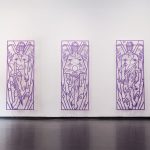
Gašper Kunšič’s most recent exhibition (Heimat Camp, on view at Škuc Gallery in Ljubljana, curated by Tia Čiček) explores the mythological meanings of an ever-changing home: always in flux and seemingly graspable, but never attainable.
 June 2, 2023 9:28 am
Published by kd_Admin
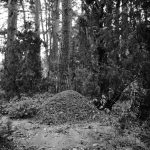
The queen, the workers, the drones, the glyphosate, the human pollinators and the RoboBees... The Mother Beehive is calling. For the first issue of their new editorial project, Yana Abrasheva & Zahari Dimitrov (editors and graphic designers based in Sofia, Bulgaria) are looking for your contributions.
 May 9, 2023 9:00 am
Published by kd_Admin
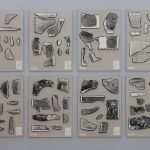
Polish photographer Monika Orpik explores the emergence of new forms of community-building in Belarus, as well as spatial experiences of migration or how people can be brought together by and under a shared spirit of solidarity.
 May 6, 2023 10:02 am
Published by kd_Admin
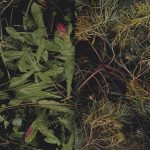
Zbyněk Baladrán's most recent exhibition (The Július Koller Society, Bratislava, curated by Daniel Grúň) explores the edges of contemporary art practices by putting forward a para-scientific cartography of global capitalism's decaying corpses.
 May 5, 2023 10:52 am
Published by kd_Admin
We are very pleased to announce the second edition of Ljubljana Art Weekend!
 February 10, 2023 5:36 pm
Published by kd_Admin
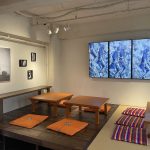
The ever-expanding Critical Thinking Series developed by Kunsthalle Bratislava has reached its sixth volume.
 January 20, 2023 8:07 am
Published by kd_Admin
New apexart international call for 2023–2024, accepting proposals starting with February 1 until March 1. More information about submitting your own project below.
 January 13, 2023 11:52 am
Published by kd_Admin
János Brückner’s latest exhibition is on display at Scope BLN in Berlin, Germany. On the occasion of the exposé, critic, editor, and art writer Zsolt Miklósvölgyi prepared an interview with the Berlin-based artist about his recent work. Interview conducted in partnership with Budapest-based Artportal.
 October 24, 2022 7:11 pm
Published by kd_Admin
As the title of the exhibition borrowed from Johanna Hedva’s 2016 essay Sick Woman Theory suggests, the works included highlight forms of coping that can be applied in the physically and mentally vulnerable state of illness. What is imagined is a world in which interdependence is the norm, in which health is a collective matter, in which vulnerability is celebrated.
 October 3, 2022 7:08 am
Published by kd_Admin
Cosmin Nicolae explores the prospects of new temporal labyrinths that are stemming from this space that we have collectively come to call Eastern Europe. To escape geo-trauma is to engage with space meta-geographically. To make sense of the future, Eastern Europe must exist polychronically. Essay originally published in Kajet Journal 05, On Easternfuturism.
 September 22, 2022 11:56 am
Published by kd_Admin
In collaboration with the JKS collective (Július Koller Society), T+U (Technologie und das Unheimliche) sets up a new exhibition in Nová Cvernovka: a part of a series that features sci-fi phantasms absorbed into an acid hypercollage against a psychedelic backdrop.
 September 19, 2022 6:15 pm
Published by kd_Admin
This article is the second part of a series of studies into Finnish vernacular photography and the impact of the forced displacement experience on photographic practices made during a stay at the Serlachius Residency in Mänttä-Vilppula (Finland) in 2019.
 August 16, 2022 11:17 am
Published by kd_Admin
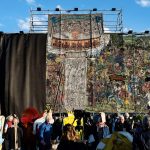
Researcher and curator Olga Stefan explores the entanglements of memory, remembrance, blood money, guilt, tainted biographies, and anti-semitism. For this particular exploit, she focuses on two separate case studies: the Taring Padi banner at documenta 15 (Kassel, Germany) and the controversial past of the Klocker Museum (Hall, Austria).
 August 2, 2022 8:43 am
Published by kd_Admin
With States of Apophenia, Rokolectiv are looking for meaningful patterns that are not really there.
 July 19, 2022 1:56 pm
Published by kd_Admin
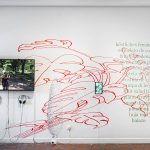
acb Gallery is proud to present its newest hybrid project involving an outdoor exhibition and a short film about Hungarian artist Adrian Kiss.
 July 14, 2022 1:13 pm
Published by kd_Admin
The current exhibition at the Budapest Gallery, curated by Flóra Gadó and Dalma Eszter Kollár, celebrates the non-hierarchical taxonomies of plants and all botanical matter. Reversing the expectations of what a conventional kingdom would consist in, Plant Kingdom entails precisely what its title does not promise: awareness of power structures, an attempt to dismantle or re-arrange hierarchical forms of being, an acutely mindful decolonial lens.
 July 13, 2022 2:17 pm
Published by kd_Admin
This article is the result of a study of Finnish vernacular photography and the impact of the forced displacement experience on photographic practices made during a stay at the Serlachius Residency in Mänttä-Vilppula (Finland) in 2019.
 June 15, 2022 6:17 am
Published by kd_Admin
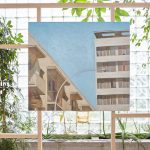
Researcher and artist Darya Tsymbalyuk focuses on the processes of displacement and the after-effects of war in Donbas by employing a fascinating epistemological lens: the disruption of human-plant relations as a result of imperialism, coloniality, and violence. At the centre of this piece, we find the concept of erasure: how to recognise its forms of manifestation and how to try to stop it from amplifying further.
 June 6, 2022 2:09 pm
Published by kd_Admin
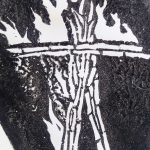
A multidisciplinary exhibition in three parts, with works by Vigan Nimani and curated by Seda Yıldız, hosted in various locations in Prishtina: Kino ARMATA, Grand Hotel Prishtina, The artist’s studio.
 June 3, 2022 6:59 am
Published by kd_Admin
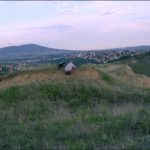
In the context of the Wild Garden Utopia project, Kitti Gosztola and Bence György Pálinkás produce a fictional account of their favourite alien plant, with some intertexts from nineteenth-century botanical sci-fi and Slovak folklore.
 May 25, 2022 3:59 pm
Published by kd_Admin
A new documentary about the city of Belgrade and the artists and collectives that shape its imagination from our friends from EYESORE Magazine.
 May 23, 2022 8:33 am
Published by kd_Admin
Nona Inescu’s most recent solo exhibition investigates emerging topographies of coexistence. By studying the geological structure of the land, new patterns of human and non-human cohabitation are brought to the fore. This decoding of the techno-sphere allows for new, less extractive as well as less exploitative dynamics to transpire, which are then re-articulated through a series of sculptural installations, photography, and video work.
 May 11, 2022 4:21 pm
Published by kd_Admin
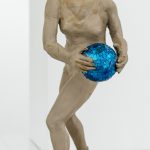
“Do things around us disappear or do they always ‘just’ change? Is everything staying here?”, asks Slovak visual artist Dana Tomečková, who was an artist-in-residence last autumn at the Studio of Young Artists’ Association (SYAA) in Budapest.
 May 5, 2022 11:09 am
Published by kd_Admin
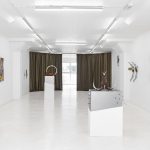
Romanian artist Vlad Nancă’s newest exhibition provides a speculative understanding of history and plunges into bottomless possibilities of new futures. The underlying premise of these progressive, futuristic, interplanetary beginnings has at its core an intriguing imaginative exercise. What if humanity had to start over again from the ground up? Would the same mistakes be made? Reflecting on these assumptions, what would a future—this time led by women—look like?
 April 27, 2022 2:51 pm
Published by kd_Admin
Aldea Gallery is pleased to announce Voracy Loop, a group exhibition by Inside Job (Ula Lucińska, Michał Knychaus) and Botond Keresztesi.
 April 21, 2022 6:52 am
Published by kd_Admin
Merging various sources from pop- and counter-culture, futuristic design, psychedelia, jazz and acid house, Márk Fridvalszki’s works seek to create a temporal spiral between the late modern era filled with utopian energies and our futureless present.
 April 20, 2022 9:28 am
Published by kd_Admin
Join the Antiwarcoalition, a new platform initiated by a group of Belarusian artists and cultural workers.
 April 7, 2022 11:46 am
Published by kd_Admin
Gintautas Mažeikis is one of Lithuania’s most prominent public intellectuals. Former student and currently media scholar at the University of Siegen, Miglė Bareikytė, talks with Mažeikis about the mediatisation of war, critical thinking, and the Left caught in an East–West conundrum.
 April 7, 2022 7:27 am
Published by kd_Admin
Put together by Julien Britnic and imagined visually by Andrei Nicolescu, the third episode of The Adventures of Rembo and the Eastern Kid marks a switch. In its newest rendition, Voltron meets Moldavian monasteries and one-dimensional societies, futuristic anime meets Rembo, the over-protective soldier, and Candy, the wide-eyed girl.
 April 6, 2022 9:01 am
Published by kd_Admin
Back in 2020, Daryna Mamaisur created these video and photo series, exploring the lost but never forgotten steppes of Eastern Ukraine. In her work, she reflects on the uneven flow of history and the representation of the natural landscape in times of ecological, military, and humanitarian crisis.
 March 26, 2022 6:06 pm
Published by kd_Admin
In her new work exhibited in the Amsterdam-based PS Project Space, Polish artist Ola Korbańska puts emphasis on the double-edged nature of things in our current realities. By contrasting and interlacing meanings at the same time, Korbańska seeks to reveal that there is always a second side to the story, and that digging deeper beyond surface layers is a necessity.
 March 26, 2022 5:45 pm
Published by kd_Admin
Back in 2020, Anna Pylypyuk and Volodymyr Shypotilnykov documented Kyiv’s fortified region, a complex of defensive structures consisting of field fortifications and engineering obstacles that stretch up to 85 kilometres, that was built from 1929 to 1941 in order to protect the old border of the USSR. Now, more than 80 years later, the future of Kyiv is being tested again.
 March 20, 2022 6:18 am
Published by kd_Admin
A statement from the team behind the Romanian Pavilion at the 2022 Venice Biennale. Here, we have not said ‘never again’ until it happened again. So may this also be a pledge for the beginning of a reckoning of all our deepest and most tormenting traumas, as well as shameful forgetting, and to come together for a non-fascist future without borders, neither inside nor at the margins of this continent of blood.
 March 19, 2022 7:08 pm
Published by kd_Admin
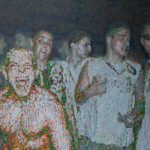
Hungarian artist János Brückner tinkers with lost pieces of early digital photography that documented techno parties in Budapest from more than 20 years ago. Through what he calls the ‘human printer’ technique, Brückner gives new meaning as well as new life to a blissful kind of ecstasy that seems so unattainable nowadays.
 March 15, 2022 8:01 pm
Published by kd_Admin
A letter of love, despair, and hope to the city of Mariupol and its people. The same people, who according to Victoria Donovan—senior lecturer, author, and writer with an interest in the Donbas region and its imaginaries—“welcomed me so warmly and shared so generously their knowledge and experiences, now fear for their lives in the city’s basements and bomb shelters. Russian shelling of the humanitarian corridors out of Mariupol means that they are stuck in the city without food, water, or heating, and today (12 March 2022) it is -5C and snowing.”
 March 9, 2022 1:51 pm
Published by kd_Admin
A new exhibition at MODEM in Debrecen, Hungary, titled BORDERLINE CASE, seeks to provide novel artistic reflections with regards to a forever-shifting Central-Eastern European identity. With a solid research to outline the historical context of the exhibition, curator Don Tamás brings together 14 artists from the region and tackles issues of language, border, and self-definition.
 March 2, 2022 7:10 pm
Published by kd_Admin
The artist Alevtina Kakhidze lives not far from Kyiv. She was active in the Maidan protests, and her performance for Manifesta 2014, in St. Petersburg, focused on the war in Eastern Ukraine. She speaks about the role of artists in conflicts, what happens to morality during war, and when it is acceptable to be a pacifist.
 March 2, 2022 10:26 am
Published by kd_Admin
Artist and filmmaker Adina Pintilie has been selected to represent Romania at the 59th International Venice Biennale 2022, with the project You Are Another Me—A Cathedral of the Body, closely developed with curators Cosmin Costinaș and Viktor Neumann.
 February 9, 2022 9:52 am
Published by kd_Admin
Cultural critic Zsolt Miklósvölgyi engages in a fascinating discussion with Polish artist Stach Szumski. The premise of this exchange is provided by the latter’s exhibition in Budapest, entitled Splittertown, and the sources of identification in his visual practice: from the free tekno scene to geological formations in south Poland, from the local graffiti scene to the area’s (urban) decay and forced modernization.
 February 1, 2022 4:53 pm
Published by kd_Admin
The main intention of the fifth issue of Kajet Journal is to tentatively sketch a re-conceptualisation of Eastern Europe’s future: to formulate a novel prototype of Easternfuturism, one that is by no means exhaustive but should be read as an invitation for new cultural, artistic, and activist entities to develop their own understandings of the concept.
 January 19, 2022 12:14 pm
Published by kd_Admin
Martin Maeller’s latest show “Soft Sorrow” is now on view at House of the Lords of Kunštát, Brno.
 January 19, 2022 8:42 am
Published by kd_Admin
Curators, artists, writers, and creative individuals, regardless of location or past experience, are invited to submit a proposal online for the new open call organised by Apex Art International.
 January 18, 2022 3:32 pm
Published by kd_Admin
A polymuseum in progress, fluent in multiple artistic languages, TRIUMF AMIRIA - Muzeul Culturii Queer [?] is researching, disseminating, and highlighting queer culture and queer artistic production in Romania.
 November 9, 2021 12:22 pm
Published by kd_Admin
Rokolectiv commissioned six new works dealing with different forms of narration and storytelling in video art. An unforeseen timespace journey from ancient Rome to Manila.
 November 1, 2021 11:17 am
Published by kd_Admin
In the context of emerging de-colonial interventions in Russia and beyond, Russian interdisciplinary researcher Sasha Shestakova critically explores the past and present web of relations in the Arctic. By using the 2020 “Interdependency as a Condition” symposium as an entry point, Shestakova discusses how contemporary planetary problems of living in more-than-human worlds can be repositioned and reconfigured.
 October 31, 2021 6:33 am
Published by kd_Admin
French curator Patricia Couvet explores novel artistic research initiatives that dwell on creative spaces that exist outside of Western canons. In their documentation, new contexts of authenticity are revealed: ones that persist despite globalising and homogenous histories and survive through alterity and local experience.
 October 26, 2021 10:20 am
Published by kd_Admin
Kajet Journal is very happy to announce the opening of “Obsession Never Sleeps”, an exhibition that seeks to examine the obsessive dimension of memory. The exhibition brings together new works by three Bucharest-based artists, Andreea Badea, Nikita Dembinski, and Robert Antoniac.
 October 26, 2021 6:05 am
Published by kd_Admin
Rokolectiv Festival presents a new online exhibition, Mars Can Wait, which seeks to visually investigate the Gaia system and its reticulate evolution.
 October 20, 2021 11:03 am
Published by kd_Admin
Kajet Journal is developing a new editorial project. For one of its forthcoming editions, which is focusing on The Real, we are inviting new collaborations that can take the shape of texts and photography series. Five such materials will be selected to be published online and in print.
 September 30, 2021 8:26 am
Published by kd_Admin
Departing from Timothy Morton’s idea that ‘all art is ecological’, Under Pressure—a new exhibition by Living Content on view at Mobius Gallery in Bucharest—seeks to provide poetic explorations that look into a potential reconciliation with what it means to be human in the age of climate crisis.
 September 22, 2021 7:54 pm
Published by kd_Admin
By focusing on an embodied approach to history and memory, curator and writer Katalin Erdődi provides a poetic exploration of The Art of Movement: a film made by dancer and choreographer Boglárka Börcsök in collaboration with filmmaker Andreas Bolm, as well as an avant-garde dance/performance movement that emerged at the beginning of the twentieth century in Hungary.
 September 21, 2021 8:14 am
Published by kd_Admin
Kamila Dzierzak seeks to build new futures out of her attachment to local forms of cultural heritage.
 September 13, 2021 4:05 pm
Published by kd_Admin
Voicing the Silence, an exhibition curated by the TOK collective and the first apexart international open call winner in Russia, is a response to the current turn that has empowered patriarchal systems across contemporary societies. Voicing the Silence showcases ways of challenging social and gender norms, unveils state mechanisms that control women’s rights and reproductive decisions, and addresses feminist movements across different countries and historical contexts.
 September 6, 2021 5:05 pm
Published by kd_Admin
ING Tech invites new possible collaborations with Romanian artists through an open call. Emerging and established artists based in Romania are welcome to submit existing as well as new works for their new HQ in the city centre of Bucharest.
 September 1, 2021 8:48 am
Published by kd_Admin
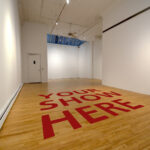
apexart is accepting exhibition proposals for its NYC Open Call from October 1-31, 2021. Curators, artists, writers, and creative individuals, regardless of experience level or location, are invited to submit a proposal online.
 August 6, 2021 1:45 pm
Published by kd_Admin
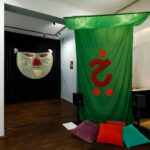
TRIUMF AMIRIA is hybridizing and expanding Zina Gallery according to its own imaginary and likeness as a queer museum growing on the fertile ground between a real institution and a utopian construction.
 June 28, 2021 1:18 pm
Published by kd_Admin
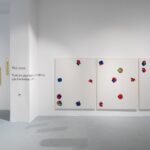
The ALTERUM project focuses on non-profit, artist-run galleries as increasingly important platforms in the context of contemporary Central and Eastern Europe. These independent initiatives have a recreational role in the cultural institutional system as they are built on experiment and flexible structures working together with young, emerging artists and curators.
 June 28, 2021 12:51 pm
Published by kd_Admin
A one-year live-generated radio stream composed from hopes, fears and dreams of contributors from around the world. What does your future sound like?
 May 28, 2021 6:33 am
Published by kd_Admin
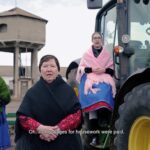
Inspired by the rich tradition of folk culture, in particular folk singing in Hungary, NEWS MEDLEY is a collaboration between London-based Polish visual artist Alicja Rogalska, curator Katalin Erdődi, folk singer Réka Annus and the Women’s Choir of Kartal, a village near Budapest in eastern Hungary.
 May 22, 2021 7:28 pm
Published by kd_Admin
Lucian Bran’s latest exhibition at Galeria ElectroPutere thematises the concept of migration by linking two different islands located along the Danube: one that was submerged—Ada Kaleh, and one that is arising—Insula K.
 May 11, 2021 12:44 pm
Published by kd_Admin
Through her installations, photos, and text-based works, Maja ∀. Ngom, an artist who comes from Poland and Senegal, explores issues of identity by referring directly to the experience inscribed in her skin colour and addressing her parent's origins. This conversation is about Maja's recent works, which unveil different modes of understanding with regards to the meaning of skin colour, and it can serve as an attempt to find an artistic terminology which can be more inclusive and open-ended.
 April 1, 2021 5:45 pm
Published by kd_Admin
Easterndaze x Berlin first took place in 2016 as a music festival and film series geared to present music from Eastern European DIY music scenes in Berlin, where music from Eastern European countries is under-represented despite the city’s proximity to Central and Eastern Europe. The Easterndaze x Berlin 2021 edition brings together community radios, zine/tape launches, video installations, panel talks, live broadcasting, and more.
 February 26, 2021 1:21 pm
Published by kd_Admin
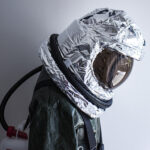
Entering the speculative realm of a fictional society of the future, Maria Persu & Mircea Andrei Florea explore the relationships between digital technology and the (post-)human, waste and habit, nature and ethics.
 February 22, 2021 11:29 am
Published by kd_Admin
Speculative designer Martina Zheng seeks to critically analyse the implications of outer space exploration in relation to migration, communication geography, nationhood, and power structures.
 February 18, 2021 7:09 am
Published by kd_Admin
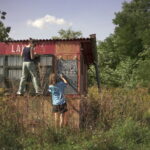
Linda Zhengová’s photo series “Showering with Glasses” serves as a utopian refuge of a radical kind of imagination, where different bodies merge and become one, regardless of their gender or normative forms of hierarchy.
 February 16, 2021 6:46 pm
Published by kd_Admin
With thirty participants from various backgrounds and countries, the second edition of the Never-never school sought to provide speculative interpretations to a large riverside brownfield in the city of Košice, Slovakia. What follows are not just the emerging futures delineated, but also the methods and ideas through which these futures were imagined.
 February 2, 2021 2:37 pm
Published by kd_Admin
For Polish artist Władysław Hasior (1928–1999), folk culture is the antidote to the colonising effects of both Western and Eastern modernist discourses. Through his idiosyncratic objects that weave a network of decolonial solidarities, Hasior seeks to tell the story of a neglected global periphery, one that bypasses the principles of the neo-avantgarde movement as well as those of Soviet-inspired socialist realism.
 January 29, 2021 3:26 pm
Published by kd_Admin
Dana Kavelina’s stop-motion animation ‘Mother Srebrenica, Mother Donbass’ (working title) narrows in on extant images of the 1941 Lviv pogroms. The one-minute and five-second clip addresses the images’ susceptibility to manipulation and, by proxy, that of the facts and legacy of the Lviv pogroms themselves. Curator and writer Alex Fisher produces an analysis of Kavelina’s animation by focusing on the tactility of her work; for Fisher, “the pictured past is terrific in its enduring tactility.”
 January 29, 2021 2:13 pm
Published by kd_Admin
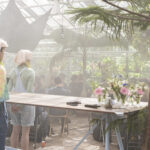
Can six-fucking the system be a thing? What can an extra finger add to an apparently obsolete toolbox of resisting against patriarchy or homophobia? Polish artist Ola Korbańska argues there is no need for us to grow anything else, except for—perhaps—bravery and some guts in order to overcome our collective struggles. For Korbańska, “the future has five fingers, open-minded heads, and bodies dancing together in solidarity.”
 January 15, 2021 8:32 am
Published by kd_Admin
Hydrangea grew out of a series of performances emphasising conspiracies and the designer realities that they generate. Navigating a tangle of digitally induced subjectivities and relationships, Hydrangea sees Holly Childs & Gediminas Žygus amidst a continuously evaporating world in which narratives dissolve, leak, fold in on themselves and loop.
 December 25, 2020 1:15 pm
Published by kd_Admin
New little bookshop in the city centre of Bucharest.
 December 12, 2020 12:36 pm
Published by kd_Admin
Artists, curators, researchers from four collectives based in different parts of the world come together to exchange ideas and questions regarding our relations to our environments and fellow life forms.
 November 27, 2020 1:54 pm
Published by kd_Admin
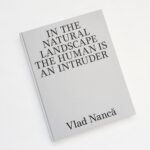
This publication is and is not an artist book: it does indeed depart from the body of works produced by Vlad Nancă, but it also shifts beyond a mere representation of the artist’s toolkit. On the one hand, this volume critically engages with Nancă’s practice, while, on the other, it utilizes his work as a backdrop in order to draw substantial conclusions regarding what we thought we knew about past and future, mankind and technology, modernism and modernity, East and West.
 November 13, 2020 2:22 pm
Published by kd_Admin
Kajet 04 author Patrycja Rozwora has launched a podcast series that aims to open up the mysterious and vague Eastern Bloc to a broader audience. Each episode is devoted to one artist/researcher exploring their relation, interest, and urgency to create within the framework of the post-Soviet sphere.
 November 4, 2020 3:26 pm
Published by kd_Admin
“Geek culture is safe. In a country that reminds me more and more of Mieville’s The City and City, where people experience their daily lives in ways that increasingly don’t intersect, geek culture can be comfortingly apolitical, ahistorical, classless, and because of that ultimately unifying, in a way.”
 October 22, 2020 10:11 am
Published by kd_Admin
Duoseries is a visual research created by juxtaposing photographs in order to define places that would not exist without human manipulation.
 October 20, 2020 1:30 pm
Published by kd_Admin
As part of the “Intervals of Attention” project, Rokolectiv commissioned ten artists to play with already existing web video formats and performativity in the context of the attention economy.
 September 23, 2020 10:29 am
Published by kd_Admin
For the fifth issue of Kajet, a journal of Eastern European encounters, we invite collaborations to take place within the realm of the future.
 September 23, 2020 6:27 am
Published by kd_Admin
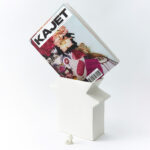
By producing an archaeology of the periphery, the fourth issue of Kajet explores the possibility of a revised vision for the future of Europe, not in a totalising manner, but in a critical, reflexive way. The fourth issue is now 25% off, buy it and support us print the Kajet 05—On Easternfuturism this winter.
 September 20, 2020 3:24 pm
Published by kd_Admin
For our 5th issue which is due in May, 2021, we are extending the Kajet family 💛
 September 16, 2020 3:58 pm
Published by kd_Admin
The prize seeks to broaden perceptions of the New East through the medium of photography. In its two previous editions, the prize has received over 1,700 entries from 25 countries.
 September 8, 2020 8:16 am
Published by kd_Admin
The “So Far, So Good” exhibition, curated by Flóra Gadó at the Budapest Gallery, examines our everyday anxieties, the compulsion to be productive, the ensuing burnout from overwork, as well as our reactions to these contemporary issues. What are the potential ways out of this situation that keeps eroding the individual? Can we take a break from it all—and if yes, how?
 September 3, 2020 7:06 am
Published by kd_Admin
apexart is accepting exhibition proposals for its NYC Open Call from October 1—31, 2020. Four winning proposals will each receive an exhibition budget of up to $10,000. More info below!
 September 3, 2020 5:50 am
Published by kd_Admin
Silvia Amancei & Bogdan Armanu’s exhibition “s.a.b.a. 1979–####” at Škuc Gallery in Ljubljana discusses contemporary politics in a realm opaque to our reality, which is emphasised by blending techniques of collage, drawing, and montage in all the media they use. In their visual narratives, they criticise Europe’s pursuit of cheap labour, the idealisation of a Western art canon, as well as the future seen as an economic calculus.
 September 1, 2020 8:10 am
Published by kd_Admin
Torn between their religion, their land, and the history of their ancestors, the Pomaks are strangers in their own country. French artist Camille Carbonaro re-creates a roadmap, a tool of battling alienation which is used to transcribe the memory, the resentments, the generosity, and the faith of a neglected people.
 August 18, 2020 1:09 pm
Published by kd_Admin
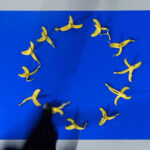
This exact moment in time feels like a sensitive turning point: we are searching for healing and restoration, but at the same time we must open up to the world, which touches upon old wounds, to ensure the sustainable perspective needed to build identity from roots to the future. This topic was selected because Maria Helen Känd, the curator of this exhibition, believes that we need more time, conversations, and opportunities to share our positions and opinions about this highly complex occurrence.
 August 16, 2020 4:16 pm
Published by kd_Admin
“We demand an investigation into these atrocities and malfeasance committed by the law enforcement agencies.”
 August 14, 2020 3:08 pm
Published by kd_Admin
“The writer’s responsibility, along with that of the institutions, ministries, and writers’ associations, is to broaden humanity through their vision, not cripple it; to create new awareness within society, not to teach conformism and corruption; his responsibility is to himself, but also towards what he creates and promotes. Without this awareness, clarity, and responsibility, the writer remains an impostor. His responsibility is a historical, political, human, and civic one. Which side of history he will end on is entirely up to him.”
 August 11, 2020 4:21 pm
Published by kd_Admin
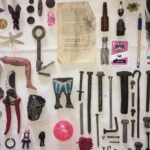
Polish sociologist, gardener, and immigrant Anna Zawadzka explores the convoluted ties between work and personal life in late capitalism, between the ivory tower of academia and the harsh conditions of groundskeeping, by critically focusing on the idealization and pathologization of labour.
 July 10, 2020 3:09 pm
Published by kd_Admin
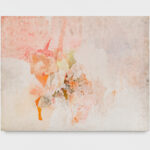
On display at Plan B Berlin until the 1st of August, Octav Grigorescu’s exhibition “LORA TAU and other stories” offers the surviving remnants of an ideal world thought to be lost. Ranging from abstract painting on canvas to book illustrations, Grigorescu’s works are fused together into an almost invisible materiality, asking to be discovered through the intuition and understanding of the viewer.
 July 10, 2020 9:50 am
Published by kd_Admin
In his most recent exhibition Blurred Lines (held at Hulu Gallery in Split, Croatia and curated by Olga Stefan), Karam Natour explores the dynamics of power structures within society. Natour, a young artist and professor at the Academy of Art and Design in Bezalel, mainly works with video—a medium which allows him to maintain an ironic and playful stance in his practice, which often involves himself and his family.
 July 6, 2020 2:09 pm
Published by kd_Admin
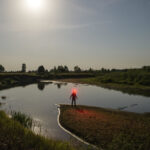
Traveling in the Chernobyl Exclusion Zone raises broader questions about humanity’s appetite for risk and the appeal of ‘dark tourism.’ Documenting those travels and experiences allows us to understand these appeals better. Iara Lee’s film Stalking Chernobyl is a powerful tool that critically tackles this desire, and is now streaming for free online, for a limited time.
 July 3, 2020 3:27 pm
Published by kd_Admin
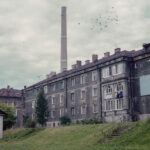
New East Poetistas is a contemporary historical record of the moment in Romanian-European-global forms of life from both a diagnostic and speculative perspective. The works of Jasmina Al-Qaisi, Ioana Cîrlig, Larisa Crunțeanu and Patricia Morosan reflect the shifting perceptions of Central and Southeastern Europe and follow the lives and occupations of those living in the region.
 July 2, 2020 10:28 am
Published by kd_Admin
Found at the intersection between breathing and screaming, Polish/Chinese musician Ai fen’s latest work explores the dissolution of the self. Natálie Zehnalová delves deeper into Ai fen’s video—which premieres on the cyberspace today—, ultimately asserting that for the experimental musician, screaming and breathing are acts of transformative liberation that empower the being.
 June 29, 2020 10:03 am
Published by kd_Admin
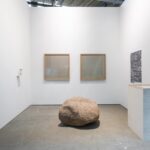
Slovak interdisciplinary artist Erik Sikora is the recipient of the 2019 Oskár Čepan Award—the most prominent annual award given to a Slovak artist under the age of forty. Art historian and writer Alex Fisher visited the Čepan prize exhibition, digging deeper into the artist’s practice, which is melding and morphing notions of grounding, abundance, and accessibility on teared levels of local, regional, national, and continental. In Sikora’s work, the particular and the ubiquitous are constantly nipping at each other’s heels.
 June 24, 2020 7:29 am
Published by kd_Admin
The Paintbrush Factory was launched in 2009 and closed down ten years later. Curator and researcher Olga Ștefan seeks to provide a deeper understanding of what The Paintbrush Factory entailed: its horizontality and organisational structure, its importance to the local community, and its existence as a model for similarly minded arts organisations. The fifth interview is with Mihai Pop, Romanian artist, gallerist and coordinator of Galeria Plan B.
 June 23, 2020 7:55 am
Published by kd_Admin
Alina Lupu is an artist and writer based in Amsterdam whose work is at the intersection between labour precarity, institutional critique, and performative practices. We talked about her praxis, transnationalism, contemporary divisions of labour, migration, and municipal elections.
 June 18, 2020 2:51 pm
Published by kd_Admin
Entering the realms of memory and nostalgia, artist and researcher Ayla Dmyterko seeks to deconstruct the surviving visual symbols and oral histories that surround a transnational, inter-generational Ukrainian-Canadian community. As part of her practice, these intersectional epistemologies are bound together by auto-ethnographic writing and studio-led investigations. To this end, Dmyterko is interested in the sites of return, reclamation, and interstice that co-exist in diasporic cultural memory.
 June 16, 2020 1:56 pm
Published by kd_Admin
The Paintbrush Factory was launched in 2009 and closed down ten years later. Curator and researcher Olga Ștefan seeks to provide a deeper understanding of what The Paintbrush Factory entailed: its horizontality and organisational structure, its importance to the local community, and its existence as a model for similarly minded arts organisations. The fourth interview is with Ciprian Mureșan, Romanian artist and editor of the IDEA Art + Society magazine.
 June 11, 2020 2:12 pm
Published by kd_Admin
Film researcher Izabella Wodzka is seeking to deconstruct contemporary cinematic representations of Gypsy, Roma, Travellers. She focuses on Papusza (2013), a film that departs from Bronisława Wajs' life—the first female Roma poet to be published—, and which represents an attempt to decolonise the knowledge that is unevenly spread with regards to such meta categories.
 June 9, 2020 8:14 am
Published by kd_Admin
The Paintbrush Factory was launched in 2009 and closed down ten years later. Curator and researcher Olga Ștefan seeks to provide a deeper understanding of what The Paintbrush Factory entailed: its horizontality and organisational structure, its importance to the local community, and its existence as a model for similarly minded arts organisations. The third interview is with Sorin Neamțu, Romanian artist and co-founder of Baril Gallery, involved with the Factory starting with 2012.
 June 8, 2020 12:02 pm
Published by kd_Admin
For Holocaust survivor Paul Celan, poetry was a “chance meeting in language-time nobody can foresee.” For Celan, darkness is not willed obscurity, rather, the poem comes out of lived experience and is “born dark.”
 June 5, 2020 10:16 am
Published by kd_Admin
In these absurd times, we are offering our sold-out issue for free in digital format. For those more generous of you, please also consider donating in order to support our activities.
 June 1, 2020 7:05 pm
Published by kd_Admin
The Paintbrush Factory was launched in 2009 and closed down ten years later. Curator and researcher Olga Ștefan seeks to provide a deeper understanding of what The Paintbrush Factory entailed: its horizontality and organisational structure, its importance to the local community, and its existence as a model for similarly minded arts organisations. The second interview is with Miki Braniște, cultural manager and curator for performing arts and interdisciplinary projects, currently president of Colectiv A Association.
 May 29, 2020 6:42 am
Published by kd_Admin
“Being queer means leading a different sort of life. It’s about being on the margins, defining ourselves; it’s about genderfuck and secrets, what’s beneath the belt and deep inside the heart; it’s about the night.” Zsolt Miklósvölgyi explores the literary spaces of Hungarian writer Péter Nádas by critically approaching the notion of queerness as liminality.
 May 25, 2020 10:26 am
Published by kd_Admin
The Paintbrush Factory was launched in 2009 and closed down ten years later. Curator and researcher Olga Ștefan seeks to provide a deeper understanding of what The Paintbrush Factory entailed: its horizontality and organisational structure, its importance to the local community, and its existence as a model for similarly minded arts organisations. The first interview is with Corina Bucea, cultural manager living and working in Cluj, Romania and co-founder of The Paintbrush Factory.
 May 4, 2020 7:10 am
Published by kd_Admin
The selected photos are a part of the “Postcards from Poland” series shot between 2012 and 2013, at the time when Julia Sokolnicka was almost always on the road. The constant state of moving allowed her to capture a change of scenery historically speaking, to visually document a transition toward something. The old and rotten slowly being wiped out, the cheap and poor, gaining stability and wealth.
 April 20, 2020 12:29 pm
Published by kd_Admin
“What’s more important? The sound or the phenomenon?” rhetorically inquiries Iancu Dumitrescu. As a largely experiential method, his approach to sound is based on exchanges between tension and relaxation, sonic microstructures and monumental climaxes. We visited Iancu Dumitrescu’s safe haven where hyperspectral music was born and talked about sonic archaeologies, paradoxes, and music as a shape shifting process.
 April 17, 2020 8:05 pm
Published by kd_Admin
The post-1989 treatment of the socialist urban landscape vividly illustrates persistent redevelopment and eradication by those in power, whether by political or economic circumstances. Urban researcher Natália Kvítková retraces the lost heritage of forsaken architecture in the form of reimagined therapeutic obituaries.
 April 14, 2020 4:25 pm
Published by kd_Admin
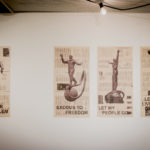
The exhibition curated by Maria Veits offers artistic interpretations of displaced stories, while reclaiming the past and the future. Focused on the space exploration of the Cold War era, the exhibition becomes even more relevant in the current times of environmental, political, and economic crisis, in a world that is still looking up to cross-planetary colonial ambitions.
 March 31, 2020 2:01 pm
Published by kd_Admin
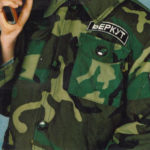
Maksym Kozlov's subjects are now able to see themselves in their deeply forgotten childhoods, during the times of irregularly changing paradigms, such as the ones from the late 1990s and early 2000s; when the last fragments of the Soviet Empire were barely visible, as they started to increasingly transition toward something else.
 March 23, 2020 8:08 pm
Published by kd_Admin
Kristin Wenzel’s first solo exhibition at SUPRAINFINIT Gallery continues her research into architecture and the production of space. For Wenzel, architecture is both a cultural symbol and a space for encounter. With "The Near and the Elsewhere", her artistic investigation enters the realm of liminality.
 March 19, 2020 4:09 pm
Published by kd_Admin
During times when society's real key workers are being revealed—not the bankers, traders, or managers, but the shelf stackers, delivery drivers, nurses, carers, bin men—, research and design collective CAPTCHA (Andrea Mologni and Margherita Marri) writes about the perilous link between infrastructure, technology, and corporate logistics at the periphery.
 March 3, 2020 6:53 am
Published by kd_Admin
Focusing on the permanent state of uncertainty that is surrounding a forever work in progress—Brașov's airport and its runway—, Mihai Șovăială's book Holding Pattern is deftly touching upon other liminal politics: governing and policing, surveillance and neoliberal capitalism, decay and privatisation, post-socialism and the public space.
 February 14, 2020 7:24 am
Published by kd_Admin
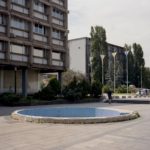
Time never stood still for Bosnia and Herzegovina, despite the long and irrational 1990s. Polish artist Monika Orpik seeks to provide a different deconstruction of a lost chronology of post-Yugoslav happenings. By focusing on the relationship between struggle and resistance across time, she comes up with three diachronic chapters that touch upon sacrifice, the end, and hope.
 February 6, 2020 3:51 pm
Published by kd_Admin
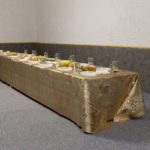
Polish photographer Justyna Górniak explores the politics of displacement that have become ingrained in the psyche of migrating communities. By focusing on the relationship between rituals and the everyday, an invigorating sense of collectivity and the pervasiveness (as well as perversity) of geopolitics, Górniak provides a hopeful reassessment of the uprooted Crimean Tatar population: although displaced and once again forced to live in an indefinite exile, their life goes on. For them, more than ever, hope is measured by the possibility to return home.
 February 6, 2020 7:11 am
Published by kd_Admin
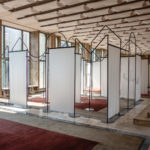
At the end of 2019, artist Larisa Crunțeanu met curator and writer Olivia Berkowicz to talk about BLUEPRINT, a walk-in installation and scenography about collective consciousness that explores similarities between the architectural plan and the clothing cutting pattern. The work took inspiration from Sala Omnia, a historical building originally designed to host the meetings of the Romanian Communist Party, which will convert into the National Dance Centre starting 2022.
 February 4, 2020 4:02 pm
Published by kd_Admin
Relying on their experience of the long 1990s and the uncertainty that characterised the post-Yugoslav space, Marija Gavrilov & Arsenije Ćatić draw forces as citizens of the periphery in order to deconstruct a contemporary Serbia found at the crossroads between East and West, between technology and all-too-present generational hurdles.
 January 28, 2020 3:35 pm
Published by kd_Admin
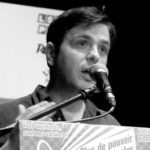
Vladimir Borțun is a political scientist and activist from Bucharest currently living in Barcelona. We spoke about borders & the East-West divide, contemporary mythologies of the past & the core-periphery cleavage, disillusionment & the European elites, and the importance of internationalism in our toolkits.
 January 22, 2020 8:51 am
Published by kd_Admin
As part of our website's relaunch, we have started a new interview series. The second to come forward is Uroš Pajović—Serbian, Berlin-based researcher and writer dealing with the intersection between architecture, the politics of space and visual arts, the post-Yugoslav landscape and self-management, as well as the East-West divide.
 January 20, 2020 3:21 pm
Published by kd_Admin
The following instances are by no means exhaustive or defining moments in the history of Eastern Europe. Rather, they should be read as suspended breaks in the region’s past, descriptive manifestations of struggling against normative and hegemonic undertakings of the status-quo; if anything they are originating in nostalgia and deracination, transience and transcendence, mythologies and demonisation, empowerment and resistance.
 December 2, 2019 7:24 pm
Published by kd_Admin
As part of our website's relaunch, we have started a new interview series. The first to come forward is Apparatus 22—a multidisciplinary art collective seeking to alter perception through radical imagination & critically explore society through the lens of contemporary art, fashion, and more.
 December 2, 2019 4:21 pm
Published by kd_Admin
“Every generation constructs a nostalgia for two or three generations behind.” We followed Vlad Nancă for a few cold days of November, visiting the last days of his solo exhibition “Vis-à-Vis” at Suprainfinit Gallery, the intimate space of his beautiful home, as well as his childhood apartment and the neighbourhood where he grew up: Drumul Taberei.
 November 29, 2019 7:30 am
Published by kd_Admin
Polish photographer Dominik Wojciechowski explores the process of identity making and its complexities in the case of the former Yugoslavia by seeking to critically understand Yugonostalgia and the post-Yugoslav identity.
 November 28, 2019 7:35 am
Published by kd_Admin
This interview with Prof. Elke Krasny was conducted by Natalia Yeromenko during the symposium In the First Person: Memory in Kharkiv, Ukraine, in connection with her lecture on curatorial materialism and feminism. Krasny, curator, cultural theorist, urban researcher and professor at the Academy of Fine Arts Vienna, framed her discussion on the materialist discourse through the term 'labour of love'. The phrase provides an entry point to ongoing issues, such as economic and employment precarity and its geographical localisation, as well as the potentialities for communitarian responses to such conditions.
 November 25, 2019 2:42 pm
Published by kd_Admin
Leninfall, besieged statues, rabid processes of decommunisation, anti-terrorist operations in Donbass, the hell of Maidan, nationalist movements—Ukraine has had it all. Kateryna Filyuk explores the emergence of a different kind of negotiation between the public space, society, the past, and contemporary art.
 November 24, 2019 9:41 am
Published by kd_Admin
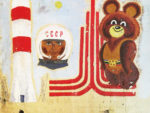
Soviet Innerness explores the places where wallpaper is torn and Pravda peeks out; where coats of paint and eerie flowers blossom; where time stands still and the unheimlich is comfortable.
 November 24, 2019 9:17 am
Published by kd_Admin
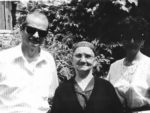
Why did my great-grandmother—and Aromanian women in general—use to have a cross tattooed on their forehead? What was the primary purpose of such a tattoo? What did it actually mean? Was it a mere aesthetic adornment? Why a cross, then? And, why on such a visible part of the body? Did it have something to do with the particularity of being Aromanian? Or, maybe it had a religious purpose behind it?
 November 24, 2019 7:21 am
Published by kd_Admin
“Intuitive respect for the law just isn’t part of Eastern Europeans’ psychological or cultural makeup. Legal is anything they can get away with; moral is anything that pays an immediate dividend.” Alexander Boot
 November 23, 2019 4:37 pm
Published by kd_Admin
In the Yugoslav history, amateur film collectives shifted from small, bourgeois circles during the 1920s, into political instruments after World War II, and, more recently, into communities entangled at the crossroads of consumerist and artistic practices. Following the structural path of amateur filmmaking and Kino Klub Zagreb’s collective practices, this study should be read as a puzzle of field notes, interviews and historical findings, personal impressions, immersions, and memories, as seen from different standpoints and over various timeframes.
 November 23, 2019 4:24 pm
Published by kd_Admin
Will Gresson explores everyday life as lived in a student accommodation called the Fforst—with its complex intricacies, multicultural diversity, and enhanced sense of collectivity.
 November 23, 2019 1:56 pm
Published by kd_Admin
In the context of the three long decades that have passed since the fall of the post-war communist regimes of Eastern Europe, how has the region dealt with its own condition of marginality?
 November 22, 2019 3:48 pm
Published by kd_Admin
Departing from the subcultural youth of 1960s Poland, their anti-structural ideas and the emergence of the bohemian proto-hipster in Polish socialism, Olivia Berkowicz uses Andrzej Wajda's 1960 cinematic masterpiece Innocent Sorcerers in order to explore the relationship between play and space.
 November 3, 2019 3:16 pm
Published by kd_Admin
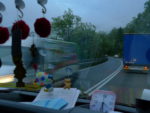
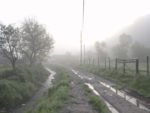
I soon realise that my chances to hitch a truck going to Bucharest overnight are increasingly minuscule. An elderly man trying to sell carved wooden souvenirs to truck drivers points towards a gas station a bit further down the dusty road. Following his advice, I walk past abandoned exchange kiosks and weathered billboards. Accompanied by a polyphonic chorus of birds and stray dogs, I watch the sunset reflected in a large fish pond next to the road.
 October 30, 2019 7:26 pm
Published by kd_Admin
In the context where the personal realm not only interacts with but actively mediates the very work of art that is being produced, it is in Herta Müller’s writings that one can find the best representation of the island man metaphor.
 July 24, 2019 1:19 pm
Published by kd_Admin
THIRD EDITION OF THE EASTERNDAZE FESTIVAL CONTINUES TO PAIR ELECTRONIC MUSIC COLLECTIVES OF EASTERN EUROPE + BERLIN TO CELEBRATE DIY ARTS & COMMUNAL ETHOS